Who Qualifies to Be Called a Christian?
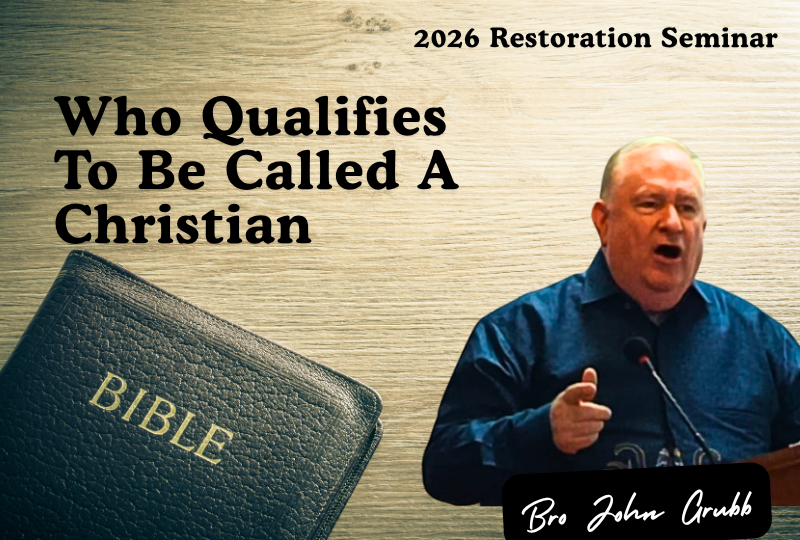
Who Qualifies to Be Called a Christian?
Bro John Grubb | 31 August 2026 | Restoration Seminar | Acts 11:26
"And the disciples were first called Christians in Antioch." — Acts 11:26
The Name First Spoken in Antioch
Only three times in the entire New Testament does the word Christian actually appear:
"And the disciples were first called Christians in Antioch." (Acts 11:26)
"Then Agrippa said to Paul, 'You almost persuade me to become a Christian.'" (Acts 26:28)
"Yet if anyone suffers as a Christian, let him not be ashamed, but let him glorify God in this matter." (1 Peter 4:16)
James adds a fourth reference to the name itself: "Do they not blaspheme that noble name by which you are called?" (James 2:7)
Some have claimed the name Christian was a derogatory nickname given by the enemies of Christ. But Isaiah prophesied differently:
"The Gentiles shall see your righteousness, and all kings your glory. You shall be called by a new name, which the mouth of the LORD will name." (Isaiah 62:2)
The name did not come from the enemies of Christ. It came from God Himself. It is a noble name, given by God, worn by every soul who belongs to His Son.
To Wear the Name Is to Belong to Christ
A Christian is a disciple, a follower — a servant, even a slave — of Christ. When a person obeys the gospel, they become His:
"…God be thanked that though you were slaves of sin, yet you obeyed from the heart that form of doctrine to which you were delivered. And having been set free from sin, you became slaves of righteousness." (Romans 6:17–18)
"…do you not know that your body is the temple of the Holy Spirit who is in you, whom you have from God, and you are not your own? For you were bought at a price; therefore glorify God in your body and in your spirit, which are God's." (1 Corinthians 6:19–20)
There is an old preaching illustration from the United States — a woman changes her name when she marries her husband, just as a Christian is married to Christ. But when you move to Asia, you find that women here often keep their name when they marry. So the illustration falls short. The deeper point is not what name the wife carries — but that we wear the name to whom we belong. And we belong to Christ, because we have been purchased by His precious blood.
The Concept of Qualification
We all understand what it means to qualify for something.
In sports — how does a national team qualify for the World Cup? They play a series of matches, and only by winning the required number, under FIFA's rules, do they earn a place. In 1980, a woman named Rosie Ruiz was declared the women's winner of the Boston Marathon — but officials quickly grew suspicious. Photographers had no images of her along the course, and she had not been recorded at any of the interval checkpoints. It was soon discovered that she had jumped into the race near the finish, having also cheated at the New York City Marathon a few months earlier. She was disqualified. She had not run the course.
In politics — to serve in the United States, you must be at least 25 to enter the House of Representatives, at least 30 for the Senate, and at least 35 for the presidency. And to be President, you must be a natural born citizen of the United States. Naturalized citizens — those who became citizens later in life — are not qualified for that office.
In the church — to serve as an elder, bishop, overseer, or deacon, specific qualifications are laid out in 1 Timothy chapter 3 verses 1–13. For leading in the assembly and preaching, Paul sets out requirements in 1 Timothy chapter 2 verses 8–12.
So what qualifies a person to be called a Christian?
Is It Enough to Just Be a "Believer"?
In the New Testament, when the word "believer" is used, it does not simply mean "someone who thinks Jesus is real." It means someone who has obeyed the gospel.
"And what accord has Christ with Belial? Or what part has a believer with an unbeliever?" (2 Corinthians 6:15)
"But concerning the Gentiles who believe, we have written and decided that they should observe no such thing…" (Acts 21:25) — this refers to Gentile Christians who had already come into the church, following the resolution of the Acts 15 dispute over circumcision and the Law of Moses.
But in the twenty-first century, the phrase "believer" is often used very differently. People say, "I am a believer," meaning only, "I believe that Jesus is the Son of God." But is that enough?
Look what actually happened with the Philippian jailer. He asked Paul and Silas:
"Sirs, what must I do to be saved?" And they said, "Believe on the Lord Jesus Christ, and you will be saved, you and your household." (Acts 16:30–31)
Many stop reading right there. But watch what follows:
"Then they spoke the word of the Lord to him and to all who were in his house." (Acts 16:32)
The jailer had not yet heard the gospel. He needed to hear it — and then to obey it. "Faith comes by hearing, and hearing by the word of God" (Romans 10:17). And James makes it plain that faith alone is not enough:
"You see then that a man is justified by works, and not by faith only… For as the body without the spirit is dead, so faith without works is dead also." (James 2:24, 26)
James is not talking about works we can perform to earn salvation. He is talking about obeying the gospel — the very thing the New Testament repeatedly calls us to do.
What Must a Person Do to Qualify
According to the Bible, there are five clear steps.
1. Hear and Study the Word of God
"So then faith comes by hearing, and hearing by the word of God." (Romans 10:17)
"No one can come to Me unless the Father who sent Me draws him… It is written in the prophets, 'And they shall all be taught by God.' Therefore everyone who has heard and learned from the Father comes to Me." (John 6:44–45)
We must first hear the gospel.
2. Believe with All Your Heart
Not part of the heart. The whole heart. When the Ethiopian eunuch asked to be baptized, Philip's answer was direct:
"If you believe with all your heart, you may." And he answered and said, "I believe that Jesus Christ is the Son of God." (Acts 8:37)
We may not have properly emphasised the kind of belief it takes to become a Christian. We say — "believe, repent, confess, be baptized, you're on your way." But we need people who are willing to believe with all their heart. Because only when a person believes with all their heart will they make the commitment necessary to live faithfully for God.
"…by which also you are saved, if you hold fast that word which I preached to you — unless you believed in vain." (1 Corinthians 15:1–2)
3. Repent of Sins
"Truly, these times of ignorance God overlooked, but now commands all men everywhere to repent, because He has appointed a day on which He will judge the world in righteousness by the Man whom He has ordained." (Acts 17:30–31)
"The Lord is not slack concerning His promise… but is longsuffering toward us, not willing that any should perish but that all should come to repentance." (2 Peter 3:9)
What does repentance actually mean? Jesus gave us the definition in a parable:
"'A man had two sons, and he came to the first and said, "Son, go, work today in my vineyard." He answered and said, "I will not," but afterward he regretted it and went.'" (Matthew 21:28–29)
That first son said "I will not." Then he regretted it. He changed his mind. He went. That is repentance — a change of mind that leads to a change of action.
There is an old illustration of Brother Marshall Keeble, an African American gospel preacher who preached across most of the twentieth century. He went to visit a woman, and her big dog was in the yard, growling. The closer Brother Keeble walked, the louder the dog grew. He picked up a stick. The dog ran at him. Brother Keeble met the charge — and in that instant, the dog turned around and went the other way. He had a change of mind. And that is a definition of repentance.
4. Confess Christ
"You are the Christ, the Son of the living God." (Matthew 16:16) — Peter's own confession.
"For with the heart one believes unto righteousness, and with the mouth confession is made unto salvation." (Romans 10:10)
Some of the rulers of the Jews believed in Jesus — but would not confess Him:
"Nevertheless even among the rulers many believed in Him, but because of the Pharisees they did not confess Him, lest they should be put out of the synagogue; for they loved the praise of men more than the praise of God." (John 12:42–43)
Were these men saved? They believed. But they would not confess. Jesus Himself gave the answer:
"Therefore whoever confesses Me before men, him I will also confess before My Father who is in heaven. But whoever denies Me before men, him I will also deny before My Father who is in heaven." (Matthew 10:32–33)
Because they loved the praise of men more than the praise of God, they would not be confessed before the Father. Silent belief is not saving belief.
5. Be Baptized (Immersed) for the Washing Away of Sins
"And now why are you waiting? Arise and be baptized, and wash away your sins, calling on the name of the Lord." (Acts 22:16)
Someone will say — "But we are saved by the blood of Christ." That is absolutely correct. Look at Revelation:
"To Him who loved us and washed us from our sins in His own blood." (Revelation 1:5)
The question is not whether the blood of Christ saves us — it does. The question is when the blood of Christ washes away our sins. It is at the point of immersion in water by a penitent believer who has confessed his faith in Christ.
Think of Naaman the leper in 2 Kings chapter 5. The prophet Elisha told him to dip in the Jordan River seven times, and he would be healed. Naaman did not want to do it. But when he finally obeyed, he was cleansed. Was the healing power in the Jordan River? No — the power was in God. But Naaman had to dip in the river in order to be healed. In the same way, the cleansing power is in the blood of Christ — but we must be baptized to come into contact with it.
"Repent, and let every one of you be baptized in the name of Jesus Christ for the remission of sins." (Acts 2:38)
"…as many of us as were baptized into Christ Jesus were baptized into His death. Therefore we were buried with Him through baptism into death, that just as Christ was raised from the dead by the glory of the Father, even so we also should walk in newness of life." (Romans 6:3–4)
"…buried with Him in baptism, in which you also were raised with Him through faith in the working of God, who raised Him from the dead." (Colossians 2:12)
A word about the word itself. Baptism is not really an English word — it is a Greek word (baptizō) that translators simply carried across into English rather than translating it. Why did they do that? Because many of the translators, though Bible scholars, were also members of denominations that practised sprinkling or pouring. So they compromised — they transliterated instead of translated. But the Greek word means one thing: immersion. It never means sprinkling. It never means pouring.
That is why, when Philip baptized the Ethiopian eunuch:
"So he commanded the chariot to stand still. And both Philip and the eunuch went down into the water, and he baptized him. Now when they came up out of the water…" (Acts 8:38–39)
If baptism were sprinkling or pouring, why not simply take a flask from the chariot and pour a little water on the eunuch's head? Because Bible baptism is not sprinkling. It is not pouring. It is immersion. That is why Philip went down into the water with him.
(A simple illustration: laundry detergent alone will not clean your clothes. You need the water. The detergent is powerful — but only in contact with the water does it do its work. In the same way, the blood of Christ is powerful — but its cleansing reaches us through the waters of baptism.)
Baptized Into the Body — Which Is the Church
We are not baptized into nothing. We are baptized into the body of Christ, which is the church:
"For the husband is head of the wife, as also Christ is head of the church; and He is the Savior of the body." (Ephesians 5:23)
"And He put all things under His feet, and gave Him to be head over all things to the church, which is His body, the fullness of Him who fills all in all." (Ephesians 1:22–23)
Salvation is in the body of Christ. And the body of Christ is the church. It is only when we are in Christ that we are truly new:
"Therefore, if anyone is in Christ, he is a new creation; old things have passed away; behold, all things have become new." (2 Corinthians 5:17)
"…and have put on the new man who is renewed in knowledge according to the image of Him who created him." (Colossians 3:10)
But it is not enough merely to be immersed. We must be immersed for the right reason, into the right church. Some people are baptized because they think they are already saved, and baptism is a public declaration of what has already happened. That is the wrong reason. Baptism is for the washing away of sins (Acts 22:16). It is into Christ, into His body, the church (Romans 6:3).
Which Is the Right Church?
Today there are more than 40,000 different Christian denominations in the world. How can any honest seeker know which one is the right one?
Jesus promised to build one church:
"…on this rock I will build My church, and the gates of Hades shall not prevail against it." (Matthew 16:18)
And He prayed for unity in that church:
"I do not pray for these alone, but also for those who will believe in Me through their word; that they all may be one, as You, Father, are in Me, and I in You; that they also may be one in Us, that the world may believe that You sent Me." (John 17:20–21)
Do you see the reason for unity? So that the world may believe. Is it any wonder that people in the twenty-first century are confused about salvation, when there are 40,000 churches all claiming to be the church Jesus built?
Paul echoed the same plea:
"Now I plead with you, brethren, by the name of our Lord Jesus Christ, that you all speak the same thing, and that there be no divisions among you, but that you be perfectly joined together in the same mind and in the same judgment." (1 Corinthians 1:10)
So how do we identify the right church? By comparing every claim we hear to the church we read about in the New Testament. Seven characteristics stand out:
1. When It Began
The church began in the last days, around AD 30, exactly as prophesied:
"Now it shall come to pass in the latter days that the mountain of the LORD's house shall be established on the top of the mountains… For out of Zion shall go forth the law, and the word of the LORD from Jerusalem." (Isaiah 2:2–3)
That prophecy was fulfilled on the first Pentecost after Jesus rose from the dead — recorded in Acts chapter 2.
2. Where It Began
Once we know the time, we know the place. The city was Jerusalem — exactly as Isaiah had foretold, and as Acts 2:5, 14 confirms.
3. What Name It Wears
The church wears the name of Christ Himself:
"…the churches of Christ greet you." (Romans 16:16)
"…to shepherd the church of God which He purchased with His own blood." (Acts 20:28)
4. Its Founder and Foundation
Jesus Christ is the founder — "I will build My church" (Matthew 16:18) — and He is the only foundation:
"For no other foundation can anyone lay than that which is laid, which is Jesus Christ." (1 Corinthians 3:11)
5. Its Organization
The church is a family of individual congregations, each under the headship of Christ, and each organised locally with elders (also called bishops or overseers) who shepherd the work of that particular congregation.
6. Its Worship
"God is Spirit, and those who worship Him must worship in spirit and truth." (John 4:24)
"'These people draw near to Me with their mouth, and honor Me with their lips, but their heart is far from Me. And in vain they worship Me, teaching as doctrines the commandments of men.'" (Matthew 15:8–9)
New Testament worship — not the doctrines and traditions of men — includes:
Singing — "speaking to one another in psalms and hymns and spiritual songs, singing and making melody in your heart to the Lord" (Ephesians 5:19; also Colossians 3:16), without instruments of music
The Lord's Supper — the unleavened bread and the fruit of the vine, on the first day of every week (Matthew 26:26–29; Acts 2:42; Acts 20:7)
Giving — on the first day of every week (1 Corinthians 16:1–2; 2 Corinthians 8–9), willingly and cheerfully
Prayer — to the Father through the Son (Philippians 4:6; Colossians 3:17)
Preaching and teaching — the whole word of God (2 Timothy 4:2–4; Acts 2:42)
7. Its Teaching on Salvation
The right church teaches what we have just walked through — hear, believe with the whole heart, repent, confess, and be baptized into Christ.
Stay Qualified — Continue Faithful
Once we have qualified — once we have obeyed the gospel and been added by the Lord to His church — the work is not over. We must continue. We must grow spiritually. We must live a faithful life. We must remain in the body of Christ to continue to have access to all spiritual blessings in Him.
There are so many people in this world who are confused about who is a Christian, and which church is the right one. It is up to us — those who have found the truth — to do everything we can to help others learn the truth, believe the truth, and obey the truth.
And if you are reading this and you have never obeyed the gospel — you have never been baptized into Christ, or you were baptized for the wrong reason — please do not put off what only the gospel can do.
We are ready to open the Scriptures with you, and to walk with you into the waters of baptism where the blood of Christ meets a penitent believer's sins and washes them away.
