What Constitutes Worshiping God in Spirit and in Truth
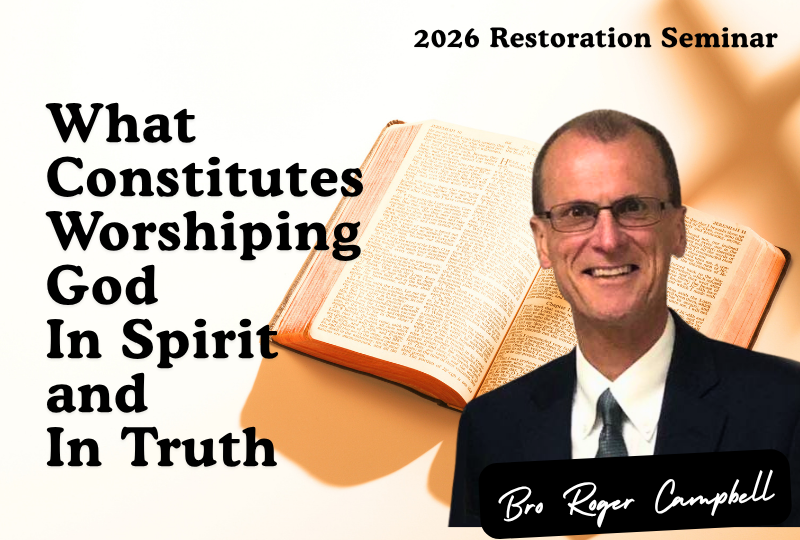
What Constitutes Worshiping God in Spirit and in Truth
Bro Roger Campbell | 31 August 2026 | Restoration Seminar | John 4:23–24
"But the hour is coming, and now is, when the true worshipers will worship the Father in spirit and truth; for the Father is seeking such to worship Him. God is Spirit, and those who worship Him must worship in spirit and truth." — John 4:23–24
What a Wonder — That God Allows Us to Bow Before Him
The Psalmist wrote:
"Oh come, let us worship and bow down; let us kneel before the LORD our Maker." (Psalm 95:6)
What a beautiful thought — that God would allow humans to bow before Him and worship Him. Out of all creation, only human beings have been given the capacity to worship the God of heaven. And when we ask the question, "What constitutes worshiping God in spirit and in truth?" we are not looking for an American answer or a Malaysian answer. We want a Bible answer.
A Look at John 4:19-24
This passage records a conversation between two people––Jesus and a Samaritan woman. Jesus spoke to her about living water, everlasting life, and her husbands. And then it was the woman, not Jesus, who raised the topic of worship:
"Our fathers worshiped on this mountain, and you Jews say that in Jerusalem is the place where one ought to worship." (John 4:20)
The Samaritans said the right place to worship was on Gerizim, and she declared that the Jews said the proper place was Jerusalem. If the Jews said that Jerusalem was the correct place, that was not their own idea — that idea came from God. Look at what Jesus said next:
"Woman, believe Me, the hour is coming when you will neither on this mountain, nor in Jerusalem, worship the Father." (John 4:21)
Jesus was not saying that it was unacceptable to worship in Jerusalem. What He was emphasizing is this: under the new covenant, there would be no designated place of worship. God can be worshiped in the Federal Territory. God can be worshiped in France. God can be worshiped anywhere on the planet — as long as that worship is offered properly.
And then Jesus described exactly what proper worship is:
"But the hour is coming, and now is, when the true worshipers will worship the Father in spirit and truth; for the Father is seeking such to worship Him. God is Spirit, and those who worship Him must worship in spirit and truth." (John 4:23–24)
There are three ideas here on which we can focus our attention.
1. The True Worshipers Offer True Worship to the True God
Jesus used a unique term, which we read in verse 23. Jesus said, “true worshipers” do something. He was not talking about puppy dogs or billy goats. He was talking about human beings. Out of all God's creation, only humans have been the capacity to worship the God of heaven. And, there is such a thing as being a true worshiper — a true worshiper is one who offers true worship to the true God. And the components of true worship are worshiping God, worshiping Him in spirit, and worshiping Him in truth.
According to Jesus, "the Father is seeking such to worship Him." The God of heaven not only wants all humans to worship, He wants us to worship Him in the proper manner. He seeks those who will worship Him rightly.
2. A Small, but Important Word — “M-U-S-T”
Look again at verse 24. There is a word in this verse that in English has only four letters, but it is not an unimportant word.
"…those who worship Him must worship in spirit and truth."
When we read the word must, we know that means it is mandatory. It is not optional. It is not preferable. It is required. If we want our worship to be accepted, if we want God to count us among the true worshipers, our worship must be in spirit and in truth.
3. In Worship to God, Sincerity Alone Is Not Enough
Sometimes people, in their sincerity and good intentions, make mistakes in the matter of worship. That even happened to the apostle John.
"Now I, John, saw and heard these things. And when I heard and saw, I fell down to worship before the feet of the angel who showed me these things. Then he said to me, 'See that you do not do that. For I am your fellow servant… Worship God.'" (Revelation 22:8–9)
What Does "In Spirit" Mean?
In the Bible, the word spirit can carry more than one meaning:
● Sometimes it refers to the eternal part of a person — "the body without the spirit is dead" (James 2:26)
● Sometimes it refers to how a person carries himself or his disposition — as when John the Baptizer was said to come "in the spirit and power of Elijah" (Luke 1:17)
● Sometimes it refers to the Holy Spirit — as when Paul writes of "walking in the Spirit" (Galatians 5:16)
But when Jesus said we must worship God in spirit, He was talking about doing it from the heart — sincerely, with the right attitude, with the right mindset. In His interaction with some of the Jewish leaders, He told them that in a prophecy of Isaiah, the prophet was talking about them:
"'These people draw near to Me with their mouth, and honour Me with their lips, but their heart is far from Me'" (Matthew 15:8).
A bystander watching them would hear some very good things. But God, who knows their heart, knows their heart is not “in it.”
When we come together to worship God, we must concentrate on what we are doing. Having such concentration is one of the hardest things that a Christian does. From the beginning of the assembly to the end, to focus and to stay focused, is not easy. We hear noises. We see things happen. Our mind wanders.
And then there is that lovely phone! If your phone is a distraction to you in worship, it is up to you to practice self-control and remove that hindrance. Put it far enough away that you cannot easily touch it. Leave it somewhere it will not tempt you. Do not allow it to become a distraction to your worship. This word is not just for seventeen-year-olds — it is equally for seventy-seven-year-olds. Worship needs to be from the heart, in sincerity.
What Does "In Truth" Mean?
The night before Jesus went to the cross, in His prayer for unity, He said to the Father:
"Sanctify them by Your truth. Your word is truth." (John 17:17)
True worshipers offer true worship from the heart in harmony with God's word. And the activities in which we participate must be authorized by the Bible.
● It does not matter what two preachers say about something.
● It does not matter what has been the practiced for sixty years in Southeast Asia. That is not the criteria.
What matters is: what does the Bible say?
A Look at What “Worship” Means
The most common Greek verb translated worship in the New Testament is proskuneō. And two respected Greek scholars — Joseph Thayer and W.E. Vine — give us clear definitions:
● Thayer says it means "to kiss the hand towards" — and in the New Testament, "by kneeling or prostration, to do homage, or to make obeisance, whether in order to express respect or to make supplication."
● Vine says it means "to make obeisance, do reverence to" — and calls it "the most frequent word rendered 'to worship.' It is used of an act of homage or reverence."
So, worship carries the sense of doing homage. Expressing respect. Not merely thinking about it. Not merely talking about it. Actually doing it.
And notice — the same Greek word is used both for proper worship (offered to God) and improper worship (offered to men or angels). Remember when Peter arrived at the house of Cornelius?
"As Peter was coming in, Cornelius met him and fell down at his feet and worshiped him. But Peter lifted him up, saying, 'Stand up; I myself am also a man.'" (Acts 10:25–26)
True Worship Is Intentional, Submissive, Actionable
Throughout the Bible, in every dispensation, God-pleasing worship is always intentional. Worship is something people do on purpose. No one has ever said, "I didn't even know I was worshiping."
Consider an instance when Ezra brought the book of the Law of Moses before the people who had returned from exile:
"And Ezra blessed the LORD, the great God. Then all the people answered, 'Amen, Amen!' while lifting up their hands. And they bowed their heads and worshiped the LORD with their faces to the ground." (Nehemiah 8:6)
Look at what they did — they stood up when the book was opened, they lifted their hands toward heaven, they bowed their heads, they worshiped with their faces to the ground. That worship was:
● Intentional — they did it on purpose
● Submissive — they did it in submission to the God of heaven
● Actionable — it involved action, doing something
That is why we sometimes speak of “acts of worship.” Again, the definition of “worship” points to doing homage or an act of reverence.
A Look at “Go to” Worship
Some people use the language “go to” worship, while others insist that we do not “go to” worship. Let’s consider some Bible examples.
Abraham — instructed by God to offer Isaac on Mount Moriah — said to the young men with him:
"Stay here with the donkey; the lad and I will go yonder and worship, and we will come back to you." (Genesis 22:5)
Jeremiah — sent by God to the people of Judah:
"…speak to all the cities of Judah, which come to worship in the LORD'S house…" (Jeremiah 26:2)
The Ethiopian eunuch — met by Philip on the desert road:
"…a eunuch of great authority under Candace the queen of the Ethiopians, who had charge of all her treasury, and had come to Jerusalem to worship." (Acts 8:27)
The disciples at Troas:
"Now on the first day of the week, when the disciples came together to break bread…" (Acts 20:7)
Before they came together, they were not together. They came together for a purpose — to worship.
The Corinthian saints:
"Therefore when you come together in one place, it is not to eat the Lord's Supper." (1 Corinthians 11:20) — Paul is correcting them because they came together for the Lord's Supper, but had failed to partake of it properly. The point is, from different locations, they came together in order to worship.
The apostle Paul — defending himself before Roman authorities:
"…it is no more than twelve days since I went up to Jerusalem to worship." (Acts 24:11)
Yes, there is a Bible concept in the Old Testament before the Law of Moses, then under the Law of Moses, and we have the same concept under the covenant of Jesus — there is such a thing as “going to” worship. That is, starting at point A and traveling to point B, for the purpose of worshipping God.
Worship Has a Start and an End
Return again to the book of Nehemiah, where we earlier read in Nehemiah 8:6 about Jews worshipping.
"Then they stood up in their place and read from the Book of the Law of the LORD their God for one-fourth of the day; and for another fourth they confessed and worshiped the LORD their God." (Nehemiah 9:3)
That would be about three hours of reading, followed by three hours of confessing and worshiping. Their worship started. And a few hours later, it was over. There was a going to worship, their worship started, and their worship came to an end.
A Look at “All Life Is Worship”
In the religious world today, there are some people who are convinced that all of life is worship — that the church assembles for church worship on the first day of the week, then everything you do from Monday morning through Saturday night is worship as a priest of God. We are not questioning anyone’s sincerity or motive, nor are we accusing anyone of having an agenda. But, the bottom line is, the concept of “All life is worship” is not biblical.
Yes, in all we do, we should strive to glorify God:
"Therefore, whether you eat or drink, or whatever you do, do all to the glory of God." (1 Corinthians 10:31)
Yes, in all we do, we should love God with all our heart, soul, mind, and strength (Mark 12:30). Yes, in all we do, we should walk worthy of the gospel of Christ (Philippians 1:27). But none of these truths should cause us to conclude that every single activity in our lives is worship. We recall those two references in the book of Acts (8:27 and 24:11) which show people going to worship.
Consider David after his sin with Bathsheba. Bathsheba gave birth to David’s child, the child became ill, and he died. When David learned that the child had died, this is what he did:
"So David arose from the ground, washed and anointed himself, and changed his clothes; and he went into the house of the LORD and worshiped. Then he went to his own house; and when he requested, they set food before him, and he ate." (2 Samuel 12:20)
Count the actions of David that are mentioned in that verse. There are nine of them:
Arose from the ground
Washed himself
Anointed himself
Changed his clothes
Went from where he was to the house of the LORD
In the house of the Lord, he worshipped
Went to his own house
Requested food
Ate
Which of those nine actions would you classify as worship? David was not worshiping when he washed his body. He was not worshiping when he changed his clothes. He was not worshiping when he walked to the Lord’s house, and he was not worshiping when he ate his food.
Only one of those nine actions was worship — the one the Bible calls worship. "He went into the house of the LORD and worshiped." Not everything in life is worship.
A Look at Romans 12:1
Some believe Romans 12:1 proves that all of a Christian's life is worship. Let us take a look.
"I beseech you therefore, brethren, by the mercies of God, that you present your bodies a living sacrifice, holy, acceptable to God, which is your reasonable service." (Romans 12:1, NKJV and KJV)
The English translations vary here — some render the phrase "reasonable service" while others render it “spiritual service” (ASV), "spiritual worship" (ESV), "spiritual service of worship" (NASB), or "true and proper worship" (NIV).
Look at the fourth word in verse 1. "I beseech you therefore…" The word therefore is a connector. It connects what Paul is about to write with what he has already written. So what has Paul been writing about? Not worship, but how to be justified.
Throughout the book of Romans, Paul has been teaching how a person is justified:
● Justified by the gospel (Romans 1:16–17)
● Justified by the blood of the Christ (Romans 5:9)
● Justified by faith (Romans 5:1)
Then Paul moves to how the justified are to live:
● Walk in newness of life (Romans 6:4)
● Present our bodies as instruments of righteousness (Romans 6:13)
● Walk after the Spirit, not after the flesh (Romans 8:4)
Finally, in the closing portion of Romans 11, Paul emphasises how, by God's wisdom and mercy, all people — Jew and Gentile alike — may be saved through the gospel.
Therefore — because of all of this — "present your bodies a living sacrifice."
In the Bible, the word “sacrifice” often refers to some form of worship, but that is not true in every case. Sometimes “sacrifice” is not talking about worship. Consider two clear examples:
Philippians 4:18 — Paul, imprisoned in Rome, received a gift of material things from the brethren in Philippi:
"Indeed I have all and abound. I am full, having received from Epaphroditus the things sent from you, a sweet-smelling aroma, an acceptable sacrifice, well pleasing to God." (Philippians 4:18)
Their "sacrifice" was not worship. It was the Philippian brethren's generosity — their good deed of helping the apostle Paul. Paul called it a “sacrifice,” acceptable to God.
Hebrews 13 — the writer speaks of two different sacrifices in two verses:
"Therefore by Him let us continually offer the sacrifice of praise to God, that is, the fruit of our lips, giving thanks to His name." (Hebrews 13:15)
Here is the idea of a sacrifice being laid down before the throne of God. It comes from our lips and involves praise — that is worship.
Please do not stop at verse 15:
"But do not forget to do good and to share, for with such sacrifices God is well pleased." (Hebrews 13:16)
The second sacrifice — doing good and sharing things with others things that will be a blessing to them — that is service. Both are called sacrifices, but they are not the same thing.
Worship is one part of serving the God of heaven, but there is a great deal more to being a child of God than just worship.
Closing
What constitutes worshiping God in spirit and in truth? In our study, we have considered these matters:
● A look at John 4:19-24
● A look at what “worship” means
● A look at “go to” worship
● A look at “All life is worship”
● A look at Romans 12:1
"God is Spirit, and those who worship Him must worship in spirit and truth." (John 4:24)
