Who Was Jesus to Command the Principles of the Sermon on the Mount?
Sermon Summary: Who Was Jesus to Command the Principles of the Sermon on the Mount?
Bro. Timothy Ting | 21 December 2025 | John 1:17
Jesus Speaks With Divine Authority — Unlike Anyone Else
Matthew 7:28–29
“And so it was, when Jesus had ended these sayings, that the people were astonished at His teaching, for He taught them as one having authority, and not as the scribes.”
The crowds were amazed because Jesus did not teach like the scribes, who relied on traditions, elders, and second-hand authority. Jesus repeatedly used the phrase “But I say to you.”
This raises the key question: Who is Jesus to speak this way?
Only someone with divine authority could correct long-held interpretations, traditional beliefs and define the true meaning of God’s law.
Jesus Is the Fulfilment of the Law and the Prophets
Matthew 5:17
“Do not think that I came to destroy the Law or the Prophets. I did not come to destroy but to fulfill.”
Jesus did not come to abolish the Law. He came to complete it, to interpret it perfectly, and to reveal its true and deeper intent. What the Law pointed toward, Jesus brought to completion. Only someone with divine authority could fulfil the Law in this way.
Throughout His life, Jesus fulfilled what had been written about Him in the Old Testament, proving that He was indeed the promised Messiah. Jesus Himself affirmed this after His resurrection:
Luke 24:44
“…all things must be fulfilled which were written in the Law of Moses and the Prophets and the Psalms concerning Me.”
In other words, the Old Testament was never an end in itself—it was always pointing forward to Christ. This is why believers today live under the new covenant, not because the Law failed, but because it found its fulfilment in Jesus.
Scripture records that over 300 prophecies were fulfilled in Jesus’ life, including:
· Born of a virgin – Isaiah 7:14
· Born in Bethlehem – Micah 5:2
· From the line of David – Jeremiah 23:5
· The suffering servant – Isaiah 53
· Pierced hands and feet – Psalm 22
· Riding on a donkey – Zechariah 9:9
· The New Covenant – Jeremiah 31:31–34
These fulfilments were not coincidences. They confirm that Jesus did not merely teach God’s Law—He fulfilled it, established the New Covenant, and revealed God’s redemptive plan in full.
Law Through Moses — Grace and Truth Through Jesus
The central verse of the lesson:
John 1:17
“For the law was given through Moses, but grace and truth came through Jesus Christ.”
Through Moses, God revealed His standards and exposed sin — but the Law alone could not save.
Through Jesus came:
Grace — God’s unearned kindness, forgiveness, and salvation
Truth — the full revelation of who God is
Jesus provides what the Law could never give: spiritual transformation.
Jesus Is the Greater Moses and the True Lawgiver
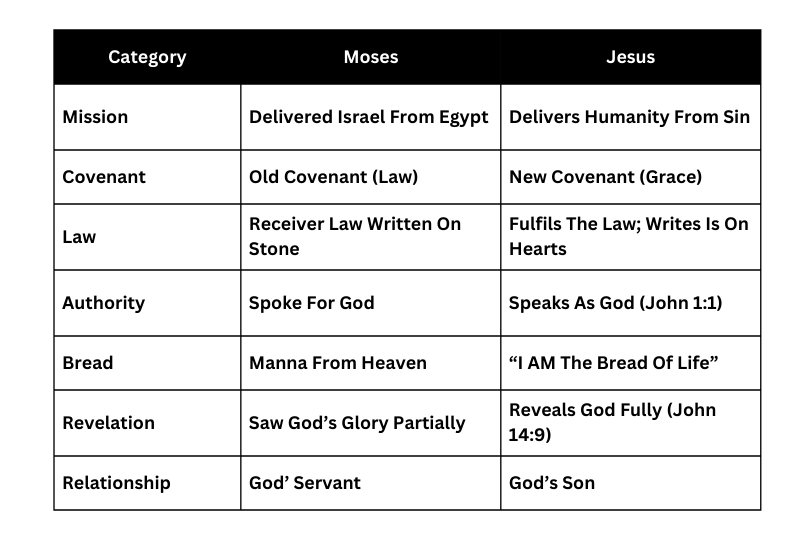
To understand why Jesus could command the principles of the Sermon on the Mount, we must see how He stands in contrast to Moses. Moses was a great servant of God, but Jesus is far greater.
Moses was sent to deliver Israel from physical slavery in Egypt; Jesus came to deliver all humanity from slavery to sin. Moses ministered under the old covenant, where the Law was written on stone tablets. Jesus brings the new covenant, fulfilling the Law and writing God’s will on human hearts.
Moses received the Law and spoke for God, often declaring, “Thus says the Lord.” Jesus, however, speaks with original authority and repeatedly says, “I say to you.” This is the difference between someone delivering a message and the One who defines it.
God through Moses provided manna from heaven to sustain Israel in the wilderness, but Jesus declares, “I am the Bread of Life.” Moses was granted a partial glimpse of God’s glory, but Jesus reveals God fully, as He Himself said, “He who has seen Me has seen the Father” (John 14:9).
The reason for this difference is clear:
John 1:14
“And the Word became flesh and dwelt among us… full of grace and truth.”
Moses knew God as a faithful servant.
Jesus reveals God because He is God’s Son.
That is why Jesus does not merely interpret the Law—He fulfils it, deepens it, and commands its true meaning with divine authority. This is why the people recognised that He taught “as one having authority” and why His words in the Sermon on the Mount carry eternal weight.
Grace and Truth Perfectly United in Jesus
Grace without truth leads us to do whatever we please.
Truth without grace becomes harsh and leaves no room for salvation.
Jesus alone holds both perfectly.
This was illustrated through the account of the adulterous woman (John 8).
The accusers used the Law to condemn, but acted unjustly. Jesus upheld the Law while extending mercy:
“He who is without sin among you, let him throw a stone at her first.”
When no witnesses remained, Jesus showed mercy without denying righteousness:
“Go and sin no more.”
This is grace and truth in perfect harmony.
Jesus Is the Son of God — Declared by the Father
Jesus’ authority comes from who He is:
Matthew 17:5
“This is My beloved Son, in whom I am well pleased. Hear Him!”
God Himself commands us to listen to Jesus.
The writer of Hebrews confirms this:
Hebrews 1:1–2
“God… has in these last days spoken to us by His Son…”
Jesus is the final and full revelation of God.
Jesus Is King of the Kingdom of Heaven
Jesus does not merely teach good morals — He announces kingdom principles.
That is why He can say:
Matthew 7:21–23
“Not everyone who says to Me, ‘Lord, Lord,’ shall enter the kingdom of heaven…”
No prophet, not even Moses, ever spoke this way.
Jesus speaks as King and Judge.
The Sermon on the Mount sets the moral foundation of the Kingdom of Heaven:
Beatitudes | Prayer | Giving | Forgiveness | Purity of heart
To follow Jesus is to live as a citizen under His reign. And we should not have any doubt that Jesus can save us or Jesus know the way on how to save us.
Conclusion: Why Can Jesus Command These Principles?
Jesus can command the principles of the Sermon on the Mount because:
He fulfils the Law and the Prophets
He is the greater Moses and true Lawgiver
He is the Son of God and final revelation
He is the King of the Kingdom He proclaims
Will you submit to Jesus’ authority?
Will you let His Word shape your heart, mind, and life?
God has done His part — sending His only begotten Son, who died for our sins and rose again so we may have eternal life.
If you Hear the gospel, Believe, Repent, Confess Jesus as the Son of God and Are baptised —you may become a child of God.
Continue faithfully to the end, living as true citizens of Christ’s Kingdom — because Jesus has all authority, and His words are life.
