Teach God’s Word but Do Not Practise Them

Teach God’s Word but Do Not Practise Them
Bro. Edward Low | 18 January 2025 | Matthew 23:1–4
Jesus’ teaching in Matthew 23 confronts one of the most dangerous spiritual conditions: knowing God’s Word, teaching it, yet failing to live by it. Speaking to both the multitudes and His disciples, Jesus exposed the hypocrisy of the scribes and Pharisees:
Matthew 23:1–4
“Then Jesus spoke to the multitudes and to His disciples, saying: ‘The scribes and the Pharisees sit in Moses’ seat. Therefore whatever they tell you to observe, that observe and do, but do not do according to their works; for they say, and do not do. For they bind heavy burdens, hard to bear, and lay them on men’s shoulders; but they themselves will not move them with one of their fingers.’”
Their authority came from Moses’ Law, and Jesus did not deny the correctness of what they taught. The problem was this: their lives contradicted their words. They instructed others but exempted themselves. This is the heart of hypocrisy — saying without doing.
History reminds us how easily this happens. The Declaration of Independence (1776) was primarily drafted by Thomas Jefferson, who later became the third President of the United States and famously wrote that “all men are created equal.”
Yet, despite this powerful declaration, Jefferson continued to own enslaved people throughout his life, and freed very few of them. Although he spoke against slavery in principle, he personally benefited from and sustained the system. This widely recognised historical contradiction makes a fitting illustration of Matthew 23—highlighting the danger of knowing and proclaiming what is right without fully living it, the very hypocrisy Jesus warned against.
Galatians 3:28 teaches that “there is neither Jew nor Greek, slave nor free, male nor female; for you are all one in Christ Jesus.” This reveals God’s standard of true equality—not just in words, but in practice.
Like the Declaration of Independence, which proclaimed equality while slavery continued, the issue is not the statement but the failure to live it out. This is exactly what Jesus condemned in Matthew 23: people who taught truth but did not practise it. Galatians 3:28 reminds us that the gospel leaves no room for superiority or hypocrisy—true righteousness is shown by living consistently with what we profess to believe.
Scripture warns plainly:
Romans 2:21–23
“You, therefore, who teach another, do you not teach yourself? … You who make your boast in the law, do you dishonor God through breaking the law?”
Matthew 7:21
“Not everyone who says to Me, ‘Lord, Lord,’ shall enter the kingdom of heaven, but he who does the will of My Father in heaven.”
Faith cannot survive on words alone:
James 2:14–17
“Thus also faith by itself, if it does not have works, is dead.”
What we say matters — but what we do matters far more.
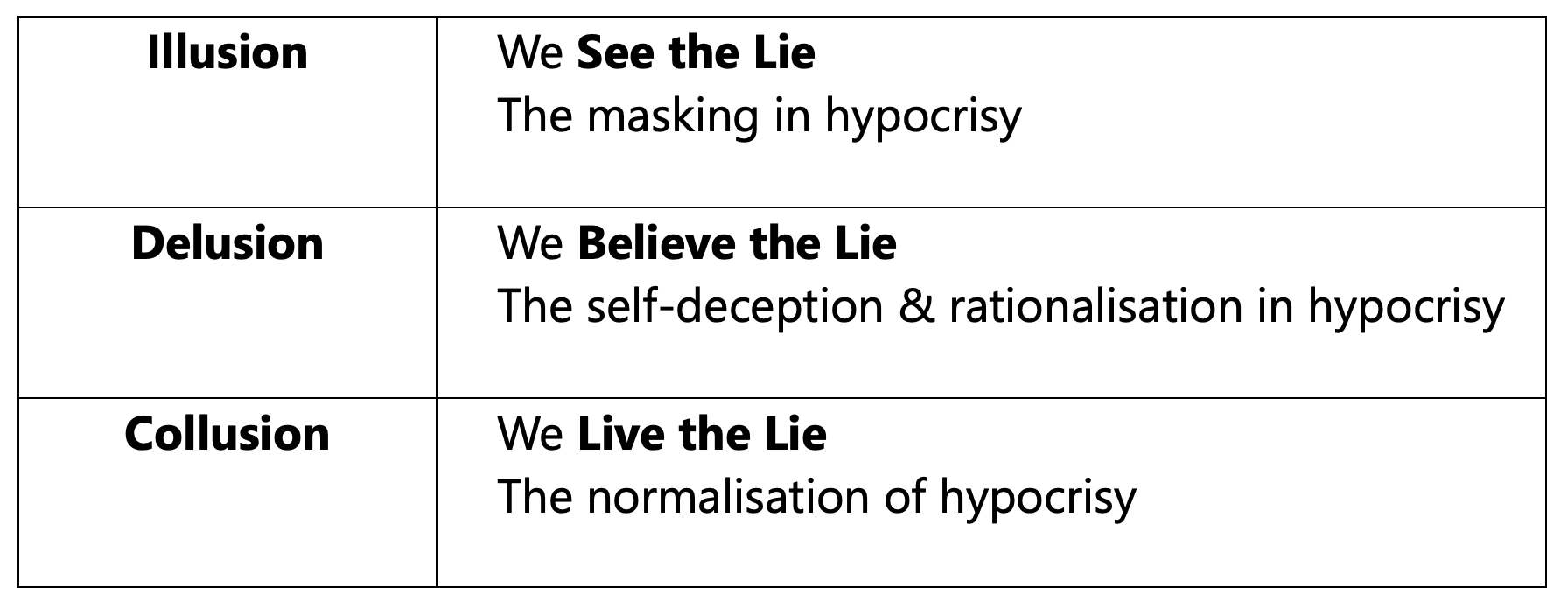
Illusion in the Mask of Hypocrisy
Hypocrisy begins with illusion — the creation of a religious image. The word “hypocrite” carries the idea of wearing a mask, performing a role. Jesus repeatedly warned against this outward show:
Matthew 6:1–2
“Take heed that you do not do your charitable deeds before men, to be seen by them… the hypocrites… have their reward.”
Matthew 6:5
“When you pray, you shall not be like the hypocrites… that they may be seen by men.”
Matthew 6:16
“When you fast, do not be like the hypocrites… that they may appear to men to be fasting.”
Outwardly, everything appears spiritual and impressive, yet inwardly the heart may remain unchanged. An image is carefully created—a performance that looks religious on the surface but masks what a person truly is. Words sound right, actions appear proper, yet what is preached is not practised.
Over time, this illusion not only convinces others but dangerously begins to convince the one wearing the mask. Hypocrisy, at its core, is saying one thing, doing another, and eventually believing the lie oneself. What is shown is holiness on the surface, while genuine righteousness is absent beneath—faith reduced to appearance rather than transformation.
2 Timothy 3:5
“Having a form of godliness but denying its power. And from such people turn away!”
Delusional Righteousness
Illusion becomes delusion when a person begins to believe the false image they have created of themselves. What started as outward appearance turns inward, and self-deception sets in.
Wrong actions are no longer seen as wrong but are reinterpreted as acceptable, justified, or even right. Through constant reasoning and rationalisation, the person convinces himself that his behaviour is tolerable—until he truly believes the lie he is living.
Luke 16:15
“You are those who justify yourselves before men, but God knows your hearts.”
Galatians 6:3
“For if anyone thinks himself to be something, when he is nothing, he deceives himself.”
At this stage, wrong actions are justified, rationalised, and defended. What once troubled the conscience now feels acceptable. People begin to redefine righteousness according to convenience rather than Scripture.
This is why Jesus’ warning is so serious — hypocrisy does not remain superficial; it reshapes the heart.
Institutionalisation of the Hypocrisy in Righteousness
Matthew 23:4
“They bind heavy burdens, hard to bear… but they themselves will not move them with one of their fingers.”
God condemned this same spirit through Ezekiel:
Ezekiel 34:2–4
“Woe to the shepherds of Israel who feed themselves! … The weak you have not strengthened… nor sought what was lost.”
Rules without compassion distort God’s righteousness, and authority without humility easily turns into cruelty—exactly what God condemned in Ezekiel 34:2–4. Through the prophet, the Lord rebuked the shepherds of Israel who used their position to serve themselves rather than care for the flock:
“Woe to the shepherds of Israel who feed themselves! Should not the shepherds feed the flocks?” (Ezekiel 34:2)
They enjoyed the benefits of leadership but neglected its responsibilities—failing to strengthen the weak, heal the sick, bind the broken, or seek the lost, and instead ruling “with force and cruelty” (Ezekiel 34:4).
This mirrors the hypocrisy Jesus exposed in Matthew 23: leaders who imposed heavy burdens on others while exempting themselves. When standards are enforced downward but ignored upward, authority becomes oppression. God’s message is clear: true righteousness leads with compassion, and true authority exists to serve, not to dominate.
Jesus and the Woman Caught in Adultery
The scribes and Pharisees attempted to weaponise the Law to trap Jesus by bringing a woman caught in adultery. Their motives were not justice but accusation. In John 8:2–11, the Law of Moses required specific conditions to be fulfilled before a person could be condemned for adultery.
John 8:7
“He who is without sin among you, let him throw a stone at her first.”
John 8:11
“Neither do I condemn you; go and sin no more.”
Jesus neither excused sin nor tolerated hypocrisy. He exposed hearts, restored dignity, and pointed to repentance — showing what true righteousness looks like.
The final stage is collusion — when hypocrisy is no longer personal but institutionalised. Leaders impose strict demands on others while excusing themselves.
Illusion, Delusion and Collusion of Sin
The Incidental Hypocrite – Peter
Peter’s failure was real, public, and painful—but it was not rooted in self-deception. When Peter denied the Lord, Scripture records his immediate inner response:
Luke 22:61–62
“And the Lord turned and looked at Peter. Then Peter remembered the word of the Lord… So Peter went out and wept bitterly.”
Peter’s hypocrisy was momentary, born of fear—not pride. His conscience was alive. He felt guilt, remorse, and sorrow. This is the danger we all face at times: saying one thing, doing another under pressure.
Yet Peter’s story reminds us that failure coupled with repentance is not fatal. The warning is clear—do not let your conscience be silenced or dulled.
The Entrenched Hypocrites – The Scribes and Pharisees
In stark contrast, Jesus exposed the entrenched hypocrisy of the scribes and Pharisees—men who practiced deception as a way of life. They were not troubled by their inconsistency; they were comfortable in it.
Matthew 23:4–5
“For they bind heavy burdens, hard to bear, and lay them on men’s shoulders; but they themselves will not move them with one of their fingers. But all their works they do to be seen by men.”
Jesus described them as outwardly impressive but inwardly corrupt:
Matthew 23:25–26
“You cleanse the outside of the cup and dish, but inside they are full of extortion and self-indulgence… first cleanse the inside of the cup.”
Matthew 23:27–28
“You are like whitewashed tombs… outwardly appear righteous to men, but inside you are full of hypocrisy and lawlessness.”
They were called blind guides:
Matthew 23:16–17, 26
“Blind guides… fools and blind… blind Pharisee, first cleanse the inside.”
Their hypocrisy was destructive—not only to themselves, but to others:
Matthew 23:13
“You shut up the kingdom of heaven against men; for you neither go in yourselves, nor do you allow those who are entering to go in.”
Matthew 23:15
“When he is won, you make him twice as much a son of hell as yourselves.”
This is hypocrisy that has become institutionalised, defended, and justified. Over time, their consciences were no longer sensitive:
1 Timothy 4:2
“Speaking lies in hypocrisy, having their own conscience seared with a hot iron.”
The Sobering Difference
Peter fell and repented.
The Pharisees persisted and justified themselves.
Incidental hypocrisy wounds the heart.
Entrenched hypocrisy kills the conscience.
The warning for every believer is clear:
Failing does not make us hypocrites—but refusing to repent does.
Closing Reflection
This lesson calls us to examine ourselves honestly:
Is my faith something I say, or something I live?
God is not moved by appearances or words alone, but by lives that practice what they profess. Truth that is not obeyed becomes empty.
May we leave determined not just to teach God’s Word, but to walk in it—humbly, sincerely, and consistently.
