Life is not Always Fair as we Live in a World of Injustice
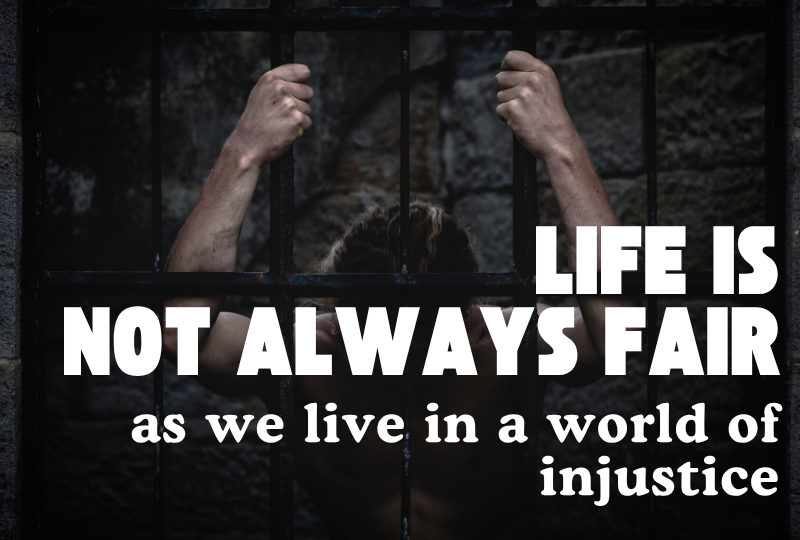
Life is not Always Fair as we Live in a World of Injustice
Bro Ong Eng Boon | 26 April 2026 | Ecclesiastes 3:18 – 4:3
Injustice Seems to Prevail
18 I said in my heart, “Concerning the condition of the sons of men, God tests them, that they may see that they themselves are like animals.” 19 For what happens to the sons of men also happens to animals; one thing befalls them: as one dies, so dies the other. Surely, they all have one breath; man has no advantage over animals, for all is vanity. 20 All go to one place: all are from the dust, and all return to dust. 21 Who knows the spirit of the sons of men, which goes upward, and the spirit of the animal, which goes down to the earth? 22 So I perceived that nothing is better than that a man should rejoice in his own works, for that is his heritage. For who can bring him to see what will happen after him?
4 Then I returned and considered all the oppression that is done under the sun:
And look! The tears of the oppressed,
But they have no comforter—
On the side of their oppressors there is power,
But they have no comforter.
2 Therefore I praised the dead who were already dead,
More than the living who are still alive.
3 Yet, better than both is he who has never existed,
Who has not seen the evil work that is done under the sun.
Through repeated trials, Solomon figured out that the true meaning of life was not living “under the sun,” but living according to God's will or in the purpose of God. He knew that humanity's best choice was to enjoy life as much as possible and trust in God's goodness and ultimate plan. He said: “12 I know that nothing is better for them than to rejoice, and to do good in their lives, 13 and also that every man should eat and drink and enjoy the good of all his labor—it is the gift of God.”
But Solomon seemed to struggle and had trouble holding on to that thought. He was prone to deep cynicism or he was skeptical towards life. In 3:16-4:3, we find him caught in this mood. Because life is often so difficult and unfair, he concludes that the dead are better off than the living, and that the most fortunate of all are those who have never been born!
Whether life has value was not Solomon's consistent viewpoint or final conclusion, for he said, “4 But for him who is joined to all the living there is hope, for a living dog is better than a dead lion.” (9:4). This is completely contrary to his previous expressions of emotion! Like us, Solomon was not immune to the turmoil of complex emotions. Sometimes he held a negative attitude towards life; at other times he viewed it with great positivity. In Eccl 3:16–4:3, his emotions were clearly severely bad and gravely critical.
We know that life itself is a struggle; but if a person has no goals in life, life becomes even more frustrating. Life seems to be nothing more than an endless repetition and mistakes, sometimes we even do things by trials and errors just like Solomon, without any real purpose or meaning. We encounter many great problems in our lives, such as harsh living conditions, loneliness, poverty, oppression by the powerful, and sometimes we feel so helpless because of our own inadequacy to cope with the troubles of the world. These things are almost commonplace and in the marketplace and we always ask why? But unfortunately, many times when a person is close to or almost understanding what is life is all about in their own way, they are already on the verge of death, or perhaps already dead.
So, what caused Solomon, and even us, to have these emotions? In the text he identifies two causes for his despair about life Eccl. 3:16-4:6.
Injustice In the World
Solomon said that one reason that led to his despair was the injustice that existed throughout the world.
Moreover I saw under the sun: In the place of judgment, Wickedness was there; And in the place of righteousness, Iniquity was there (3:16).
There’s something very relevant about Solomon’s statement. It sounds like something we’d see on the news today. You would think that people in positions of authority would be the kind of people that you can respect and trust. But we’ve seen so much in the way of corruption and lying and immorality in our government officials that we’ve come to expect it.
Then I returned and considered all the oppression that is done under the sun: And look! The tears of the oppressed, But they have no comforter— On the side of their oppressors there is power, But they have no comforter (4:1)
Can you feel the pain in these words? There is something within us that longs for justice. If someone is being oppressed, there ought to be someone there to comfort them, someone there to relieve the oppression, someone there to make things right. But Solomon says sometimes the oppressors are the ones who have all the power. It’s not fair, but that’s the way it is.
You see Solomon recognized that life can be grossly unfair, and in the very situations and places where justice ought to be served, yet the very opposite happens! The circumstances are too common to need illustrations. We live in a world of injustice and corruption of power and the problem is, where those most need help get it the least. Sadly, this oppression and distortion of justice and righteousness exist “under the sun.” This heartbreaking human reality is visible everywhere.
In Eccl 3:17 as regards to judgment Solomon has this to says, “ I said in my heart, “God shall judge the righteous and the wicked, For there is a time there for every purpose and for every work.”
Here it contains the first of two “I said in my heart” comments (Or in my heart of hearts : Deep down, in one’s truest, inner self) . Solomon makes his first observation about judgment. The “time” will come when the wicked will pay for their actions. Regarding the heartbreaking lack of justice and righteousness, Solomon comforts himself with the truth that God will one day restore everything to its proper order. He points out that “God shall judge the righteous and the wicked.” In Matthew 13:30, Jesus uses the parable of the tares to illustrate the separation that will take place on the last day. While the wicked may seem to escape the consequences of their actions, Solomon's words assure us that “[everything] and [every work] has its appointed time.” He indicates that on Judgment Day, every “thing” (failure to do the right thing) and every “action” (oppression or failure to judge fairly) will be dealt with by God.
The Inevitability of Death
Next, we see several observations by Solomon (Eccl 3:18-22
1) God tests mankind to teach them that they are similar to wild animals in some ways (3:18).
2) Both humans and wild animals will die and return to dust (3:19).
3) No one knows what happens to the breath of a human or a wild animal after death (3:20, 21).
4) Man should learn to find joy in what he does (3:22a).
5) Man cannot predict what will happen in the future (3:22b).
We must not go too far in interpreting this section, nor can we draw conclusions without carefully considering the context of Solomon's observations. For example, 3:20, 21 do not provide grounds for rejecting the belief in an afterlife. Solomon does not deny the existence of an afterlife.
Solomon writes a second time in this chapter, “I said in my heart,” indicating what he observed and then confirmed for himself. He points out that God “tested mankind.” The nature of the test seems to relate to death. No matter how high man’s notions of himself maybe, or how intellectually superior he may see himself in regard to the animal kingdom, they still cannot avoid the grave. Therefore, it is a test that no one can pass (and the failure rate is staggering, given how many people die every day). The reality of death is a way for God to “set eternity” in our hearts (3:11). We are unwilling to acknowledge that death is the end of everything. We yearn for something more (you yearn for more money? No! No way your money can follow you to the grave, we long for something “beyond” death.”
The purpose of the “test” was to make people understand that, in terms of death, “that they were no different from beasts.” Without God, what difference is there between humans and beasts? What makes humans unique and distinctive is their potential to have a relationship with God. Without this relationship, humans are no different from beasts. This verse can be interpreted as: “God showed them this so that they could see that they—they themselves—were no different from animals.” Interestingly 2 Peter 2:12 says that false teachers are like “natural brute beasts.”
Another “all is vanity” of in Ecclesiastes appears in verse 19: an overemphasis on life and living. With God, life is valuable (as mentioned earlier and reiterated later). Without God, life is a pitiful waste. Life is only truly life when God is included (John 10:10) [don’t exclude God from your life, you need to cling on to God at all costs].
Furthermore, Solomon was letting the reader (you and me) a similarity between people and beasts: both live and die; both come from dust and return to dust. This ultimate “fate” is the same for all living beings. The comparison between man and beasts are reflected in four areas: they share the same “fate”—death; they share the same “breath”; they have the same number of “advantage”[s]; and they both ultimately face decay in the grave (“return to dust”). These ideas continue up to 3:21 to prove the initial statement in verse 18 (Concerning the conditions of the sons of men. God tests them, that they may see that they themselves are like animals).
Solomon observes that man and beast “go to the same place” (3:20) – that is, “the dust” – which reminds us of Genesis 3:19. The idea of man’s returning to the dust is recurring in the Scriptures (see Job 10:9; 34:15; Psalm 104:29; 146:4). Solomon speaks in a purely physical sense about what happens to the bodies of both man and beast. Later he mentions Sheol or Hades (9:10). Man is not constructed from any physical substance that separates him from the animal world; we are all made of the same material. Therefore, we return to the fundamental point: Man is not special apart from God.
Since man and beast eventually end up as dust, what about their “breath” (or “spirit”; 3:21)? Does something different happen to the human breath or spirit as compared to what happens to that of a beast? The word used here is “ruach” in Hebrews and the Greek equivalent is “pneuma.” Compared to the breath or soul of beasts, does man’s breath or spirit change? The “spirit” and “soul” in this verse are also written as “ breath,” the same word as the “breath” in verse 3:19. This word seems to refer to the life force of living beings. What changes occur to the “breath” after death?
Here Solomon evidently had in mind about the afterlife. Solomon is stating a fact, not asking a question. Only God knows what will happen to the “spirit of man” and the “soul of the wild beast.” He says, “the breath of man rise upward (goes to God), and the breath of beast descends downward into the earth.” This fits the overall context he mentioned earlier that man will appear before God to be judged (3:17). It also aligns more closely with later statements in the book, such as Solomon's statement in 12:7 that the human spirit goes back to God who gave it. And in 12:13, 14, he affirms that all people will appear before God, and God will judge each one based upon what he or she did on earth.
Solomon reiterates " in verse 22. He echoes "I saw" from verse 16. His comments in this section relates to what he saw. He concludes that people should find joy in their daily lives and enjoy being in God's presence. What happens after death is beyond the control of man. Therefore, God's intention while people continue to live in the flesh is for them to be happy! Because they have no part in what happens on earth after death.
Beginning in Chapter 4, the next major theme Solomon discusses is that of “oppression” (4:1). The word “ashaq,” referring to both the oppressed and the oppressor, appears three times in this verse. The oppressed are powerless. This thought was especially troubling to Solomon. In observing human behavior, he witnessed the abuse of power and the misery experienced by the afflicted. The oppressed, without comfort, may be overwhelmed by a sense of helplessness. Equally disturbing is the fact that cruel men are given power—absolute power corrupts absolutely. Why does God allow this? In the Mosaic Law, God addresses the humane treatment of others. For example, Exodus 22:21-24 says, “You shall not wrong a stranger…the widow or orphan.” God will be the avenger of the oppressed. Solomon did not see the avenger appear as frequently as he should have. In fact, God desires that His people strive for equal rights and justice. The phrase “under the sun” here indicates the pervasiveness of oppression.
The dead cannot be oppressed, so Solomon “congratulated” them (4:2). From his viewpoint, it is an advantage for a person to have never seen or experienced the evil that men currently inflicting upon others. How are these words of Solomon to be taken? Basically, Solomon views death as a victory, because after death, one escapes human evil and receives his reward from God. It is best for a person not to know all the evil (oppression) that people do to others
This oppression is “under the sun”; it is everywhere. Where can man go to escape the inhuman treatment of man? “Nowhere,” Solomon was saying, “except the grave.” Many philosophers hold the view that it is best for a person never to be born rather than witness the evil happening in the world. However, we must keep in mind God’s overall plan when considering this verse. As Asaph expresses in Psalm 73, the wicked may seem to succeed, but ultimately they will face God’s judgment. The godly perspective is that, even if we witness oppression and be sadden by it, we know that justice will ultimately be served. “Vengeance is Mine, I will repay” (Romans 12:19b).
Other biblical figures expressed similar views. Job lamented
"20 “Why is light given to him who is in misery, And life to the bitter of soul, 21 Who long for death, but it does not come, And search for it more than hidden treasures;
22 Who rejoice exceedingly, And are glad when they can find the grave? (Job 3:20-22)
Jeremiah asked this question:
“Why did I come forth from the womb to see labor and sorrow, That my days should be consumed with shame?” (Jeremiah 20:18)
Solomon recognized that life can be very unfair, and in situations and places where justice should prevail, the opposite often occurs. This is so common that examples are unnecessary. We live in a world of injustice and corruption, where those most in need receive the least help, and where "man oppresses man and harms man."
Injustice is disheartening. We can endure much suffering and hardship, as long as things eventually turn out well, but as he observed, things are not always so.
Clearly, Solomon had seen much of this injustice
“If you see the oppression of the poor, and the violent ]perversion of justice and righteousness........” (5:8).
“All this I have seen, and applied my heart to every work that is done under the sun: There is a time in which one man rules over another to his own hurt” (8:9).
“There is a vanity which occurs on earth, that there are just men to whom it happens according to the work of the wicked; again, there are wicked men to whom it happens according to the work of the righteous. I said that this also is vanity“ (8:14).
We can all at some point agree with Solomon's observation: life is often unfair, and injustice often makes us angry and frustrated. There must be better ways to cope with life's sadness and injustice than to become a cynic.
Even in moments of cynicism, Solomon offers two clues on how to avoid becoming cynical about life.
First, we shouldn't dwell on the negative. Even in cynicism, Solomon acknowledges that for most of us, life isn't all bad: “So I perceived that nothing is better than that a man should rejoice in his own works, for that is his heritage......” (3:22). Even in injustice, in the face of death, we can find joy and happiness. Cynics become cynics because they choose to focus on the "bad things" in life. To avoid cynicism, we don't need to deny the bad things, but rather remain objective and recognize the good things as well.
Second, we should remember that all mistakes will eventually be corrected. In 3:17 states a truth “above the sun”: "“God shall judge the righteous and the wicked,
For there is a time there for every purpose and for every work.” There's an old saying, “What goes around, comes around” even the worst injustices in life! Eventually, all things are set right by a just and merciful God. God's judgment is not only punishment for the wicked, but also reward for the righteous and the vindication of the oppressed. Therefore, the scriptures teach Christians not to fear judgment, but to look forward to it! Judgment Day will be a great moment when all mistakes in life will be reversed.
Conclusion
How does God want us to live our lives? Solomon identified two aspects of the God-given life (3:12). First, He wants us to “rejoice.” God does not intend for us to walk around with sad faces, unable to enjoy anything in this life. We should “rejoice in the Lord always” (Phil. 4:4). Second, we should “do good.” God does not sanction (nor does Solomon, for that matter) the self-centered life. Much goods remained to be done, and we should do it during the short time, in one’s life time while we are on this earth.
In a world that is filled with lying, cheating and injustice (3:16). It is essential that Christian maintain the highest ethical standards. God intends for Christians to be “the salt of the earth” and “the light of the world” (Matt. 5:13,14).
Without God, man is nothing special; he is much like an animal. With God, however, man has an opportunity for a special relationship - and a future.
To Our friends who are here this morning, Jesus Christ came into a sin-filled world, experienced the worst of injustices, and preached good news to the poor in spirit and promised life abundant to those who believe and obey. He thus lifted our sights to a higher plane – definitely an “above the sun” plane.
“4 But God, who is rich in mercy, because of His great love with which He loved us, 5 even when we were dead in trespasses, made us alive together with Christ (by grace you have been saved), 6 and raised us up together, and made us sit together in the heavenly places in Christ Jesus” (Eph. 2:4-6).
He will ultimately judge the world in the end and that mankind now is divided by the way in which we respond to Him. You can be a cynic and deny what Jesus offers, or you can be a believer and receive life that is eternal.
