Moderate Drinking — Is It Permissible?
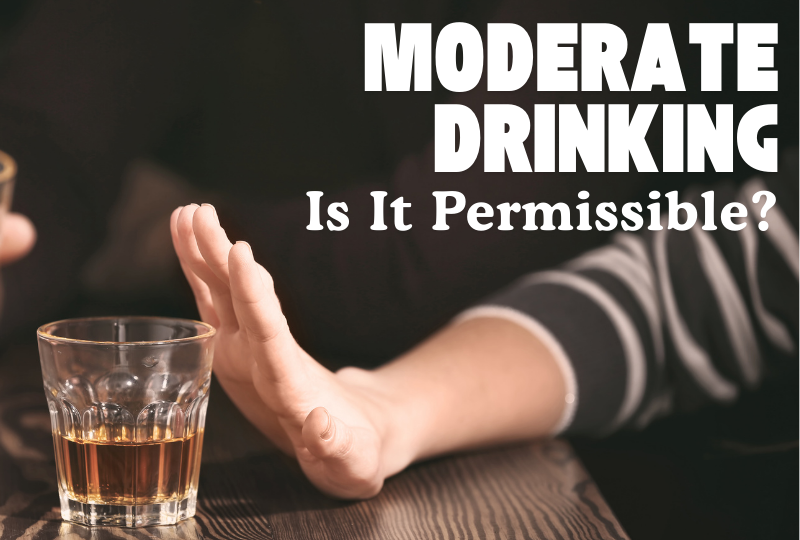
Moderate Drinking — Is It Permissible?
Bro Lee Chee Thim | 8 March 2026
Few topics draw as much debate among Christians as the question of alcohol. Some appeal to 1 Timothy 5:23, where Paul advises Timothy to use a little wine for his stomach's sake and frequent infirmities, to argue that moderate drinking in private is perfectly acceptable. Others go further, suggesting that moderate social drinking in private causes no harm to anyone around them.
Some even point to John 2 — the wedding at Cana — as evidence that Jesus Himself endorsed alcoholic wine by turning water into it. Across cultures, the clinking of glasses, the "cheers" and the "yam seng", carries a sense of celebration and belonging.
So why does the Church of Christ take such a conservative position?
This lesson approaches the question from five directions: the Bible's own perspective, the well-documented social impact of alcohol, the growing weight of medical and health evidence, a careful look at what the original Greek words for "drunk" and "excess" actually mean, and keeping our body healthy and focused to serve God.
Together, they form a clear and compelling answer — out of love for God, love for our bodies, and love for those around us.
What Does the Bible Actually Say?
The starting point is Scripture itself. Apostle Paul is direct about who will not inherit the kingdom of God:
1 Corinthians 6:9–10
"Do you not know that the unrighteous will not inherit the kingdom of God? Do not be deceived. Neither fornicators, nor idolaters, nor adulterers, nor homosexuals, nor sodomites, nor thieves, nor covetous, nor drunkards, nor revilers, nor extortioners will inherit the kingdom of God."
Drunkards — placed in the same list as fornicators, idolaters, and thieves. This is not a soft warning. It is a sobering declaration about the seriousness with which God views the loss of sobriety.
But what about the wedding at Cana?
The Greek word used in John 2 is oinos — a word that in the ancient world represented both fermented wine and unfermented grape juice. It did not exclusively mean alcoholic wine. Critics of total abstinence often cite John 2:10, where the master of the feast compliments the quality of what was served, as proof that Jesus provided intoxicating wine for already well-drunk guests.
But this reading creates a profound theological problem.
Would Jesus — the One who declared in Galatians 5:21 that drunkards shall not inherit the kingdom of God — add to the intoxication of men who had already been drinking freely? Would He, who came to free us from sin, become an enabler of drunkenness?
John 2:10
"And he said to him, 'Every man at the beginning sets out the good wine, and when the guests have well drunk, then the inferior. You have kept the good wine until now!'"
The answer comes through Isaiah 65:8, where "new wine" — unfermented grape juice still in the cluster — is explicitly described as a blessing from God:
Isaiah 65:8
"Thus says the LORD: "As the new wine is found in the cluster, And one says, 'Do not destroy it, For a blessing is in it,' So will I do for My servants' sake, That I may not destroy them all.""
Jesus cannot contradict Himself. He did not hand a gift of drunkenness to men already well-drunk and then condemn drunkards to hell. What He gave them at Cana was a blessing — the finest of new, unfermented wine. The miracle was one of abundance and grace, not an endorsement of alcoholic excess.
Galatians 5:21
"envy, murders, drunkenness, revelries, and the like; of which I tell you beforehand, just as I also told you in time past, that those who practice such things will not inherit the kingdom of God."
What the Medical Evidence Tells Us
Some dismiss the Church’s position on alcohol as old-fashioned conservatism. But in January 2025, U.S. Surgeon General Dr. Vivek Murthy issued a formal advisory on alcohol and cancer risk, calling for alcohol warning labels to be updated to include cancer warnings. Reported by The Star in January 2025, this was not a fringe opinion, but a position advanced by America’s leading public health office, reflecting longstanding scientific evidence linking alcohol consumption to cancer.
The advisory states that alcohol contributes to nearly 100,000 cancer cases and notes that this is greater than the number of alcohol-associated traffic crash fatalities, about 13,500 annually
What happens at the cellular level helps explain why. When alcohol is metabolised in the body, it breaks down into acetaldehyde, a toxic chemical and probable human carcinogen that can damage DNA and proteins. Alcohol also generates reactive oxygen species that can damage DNA, proteins, and lipids through oxidation. The U.S. Surgeon General’s advisory states that alcohol is causally linked to at least seven types of cancer, including breast cancer.
Defenders of moderate drinking often point to resveratrol, a compound found in grapes, as evidence that wine may benefit the heart. Mayo Clinic notes that grapes and grape juice can provide some of the same potential heart-related benefits without alcohol. So even where grape-derived compounds may offer benefit, alcohol itself is not necessary to obtain them.
And alcohol can be addictive. Over time, repeated use, especially heavier use, can lead to dependence and alcohol use disorder in some people. What begins as controlled use does not remain harmless for everyone.
The Social Cost of Alcohol
Research compiled by WVBS (World Video Bible School) documents what alcohol does not just to individuals, but to families and communities.
Its destructive impact can be seen in spousal abuse, child abuse, drownings, violent crime, and even murder or attempted murder. These are not minor side effects, but serious areas in which alcohol has repeatedly been associated with harm, broken lives, and shattered homes.
What is often defended as a personal liberty or social habit has, in many cases, contributed to suffering within families, danger in communities, and the loss of human life. The issue is not merely whether a person drinks, but what drinking can lead to when judgment is impaired and self-control is weakened.
What the Greek Actually Means — Methusko and Excess
One of the most common arguments made in defence of moderate drinking is this: the New Testament never explicitly forbids drinking in moderation — it only forbids drunkenness.
The go-to verse is Ephesians 5:18, and the argument runs that a Christian may drink as long as they stop before becoming drunk.
Ephesians 5:18
"And do not be drunk with wine, in which is dissipation; but be filled with the Spirit,"
It sounds reasonable — until you examine the original Greek. The word translated "be drunk" here is methusko — and it is an inceptive verb. In Greek grammar, an inceptive verb does not describe a completed state; it marks the very beginning of an action or condition.
Methusko means to begin to be drunk — to start the process of intoxication. In English, we use auxiliary verbs to convey this: "he began to run", "she started to cry". In Greek, the inceptive meaning is built into the verb itself.
So when Paul writes "do not be drunk with wine", the command in the original Greek is: do not even begin the process. Do not take the first sip that sets you on that road. This is not an instruction to drink carefully and stop before you tip over the edge. This is a command not to step onto the slope at all.
Wishing the verse meant something more permissive is wishful thinking.
The word translated "dissipation" or "excess" in Ephesians 5:18 is equally important to understand correctly. In common usage, people assume it refers to an excessive quantity of alcohol — drink too much and you've crossed the line.
But the Greek word here does not refer to excess quantity. It refers to ungodly, riotous behaviour — the moral disorder that flows from losing self-control. The theologian Albert Barnes, in his commentary on Ephesians 5:18, notes that the verse points to the character of the places and behaviours associated with drinking — places that are simply not fitting for a Christian.
Happy hours. Social drinking events. The culture that surrounds alcohol. These are not environments where the follower of Christ ought to be found.
The breathalyser analogy further dismantles the idea of "safe" moderate drinking. The Journal of the American Medical Association established as far back as the 1960s that impairment of driving skills can occur at any amount of alcohol — even below the legal Blood Alcohol Concentration limit. A single glass of reduced-alcohol beer is enough to produce relaxation and slight body warmth, a measurable decline in visual tracking ability, a reduced capacity to perform two tasks simultaneously, and the beginning of altered mood and impaired judgement.
Impairment does not begin at drunk. Impairment begins with the first drink.
The account of David and Uriah in 2 Samuel 11 offers a vivid biblical illustration of how alcohol is used to lower a man's defences and compromise his integrity:
2 Samuel 11:13
"Now when David called him, he ate and drank before him; and he made him drunk. And at evening he went out to lie on his bed with the servants of his lord, but he did not go down to his house."
David used alcohol as a weapon — to cloud Uriah's mind, to break down his honourable resolve to return home to his wife during wartime. Even this modest, managed intoxication was enough to become a tool of manipulation and sin. Alcohol changes people. Even a little.
You Are the Temple — Priest and Church
Beyond the medical and social arguments lies the deepest reason of all: our bodies are not our own. The Spirit of God dwells in us. We are the living temple of God.
1 Corinthians 3:16
"Do you not know that you are the temple of God and that the Spirit of God dwells in you?"
1 Corinthians 6:19
"Or do you not know that your body is the temple of the Holy Spirit who is in you, whom you have from God, and you are not your own?"
If the Spirit of God lives within us, what business do we have introducing a substance that impairs the mind, damages the cells, and dulls the senses that God has given us?
Jesus Himself said in John 6:63 that the Spirit gives life. Our bodies are meant to be vessels of that life — maintained, honoured, and kept ready to serve.
John 6:63
"It is the Spirit who gives life; the flesh profits nothing. The words that I speak to you are spirit, and they are life."
Peter describes the life we have left behind:
1 Peter 4:3
"For we have spent enough of our past lifetime in doing the will of the Gentiles—when we walked in lewdness, lusts, drunkenness, revelries, drinking parties, and abominable idolatries."
Drunkenness, revelries, drinking parties — these belong to the old life, not the new. We have spent enough time in those places. The call of the Gospel is to walk away from them entirely.
The Old Testament Levitical law is instructive here. In Leviticus 10:9, God gave an explicit and absolute command to the priests who served in the tabernacle:
Leviticus 10:9
"'Do not drink wine or intoxicating drink, you, nor your sons with you, when you go into the tabernacle of meeting, lest you die. It shall be a statute forever throughout your generations,'"
Two spirits do not mix — the spirit of alcohol and the Holy Spirit cannot coexist in the same dwelling without conflict. If the Levitical priests — serving in the earthly tabernacle — were forbidden from drinking intoxicants before entering God's presence, what does that say to us?
We are under a better priesthood. We serve a better temple. And the temple we serve in is our own bodies, where the Spirit of God dwells not just during worship, but twenty-four hours a day, seven days a week.
1 Peter 2:5
"you also, as living stones, are being built up a spiritual house, a holy priesthood, to offer up spiritual sacrifices acceptable to God through Jesus Christ."
We are both priest and temple simultaneously. Under the New Covenant, the standard is not lower than the Old — it is higher. The OT priest who drank was struck dead. We will not be struck dead for drinking. But that is not an invitation to lower the standard; it is a call to embrace a higher one — voluntarily, from a heart that understands what it means to be indwelt by the living God.
1 Corinthians 3:17
"If anyone defiles the temple of God, God will destroy him. For the temple of God is holy, which temple you are."
The Invitation — Be Holy, For He Is Holy
Let us be honest with ourselves.
The question "is moderate drinking permissible?" is often really the question: "how close to the line can I get?" But that is the wrong question.
The right question is: "How can I honour the God who dwells within me?"
Ephesians 5:18, rightly understood through its original Greek, does not permit social or moderate drinking. It forbids even beginning the process. Methusko — don't start.
Medical evidence confirms that alcohol causes cancer, contributes to accidents, and offers no heart benefit that cannot be obtained more safely through grape juice.
The social evidence shows that alcohol leaves a trail of broken families, violence, and ruined lives.
Even a single glass impairs judgement and begins to alter mood. And the argument from resveratrol collapses the moment you realise the same compound exists in grape juice without any of the harmful effects.
Ask not, “How much can I get away with?” but, “How can I best honour the God?”
The answer is not in testing the boundaries of what is permitted, but in embracing the beauty of what is holy.
“Be holy, for I am holy” – 1 Peter 1:16
