The church of Christ is not a cult
The Church of Christ is Not a Cult: A Gentle and Ready Defense
Bro Lee Chee Thim | 1 September 2025 | Restoration Seminar
Introduction: A City on a Hill
Why is this topic important? From the 19th to the 20th century, the church of Christ has sometimes been unfairly labeled a "cult" by outsiders, often due to theological misunderstandings. Like the genuine cultured pearls of Kokichi Mikimoto that were once slandered as fakes, the church's identity has been misrepresented.
We are therefore called to be prepared to give a clear, humble, and informed answer about our faith. The apostle Peter instructs us:
1 Peter 3:15 (NKJV): "But sanctify the Lord God in your hearts, and always be ready to give a defense to everyone who asks you a reason for the hope that is in you, with meekness and fear;"
Jesus declared His followers to be the very opposite of a secretive group:
Matthew 5:14-16 (NKJV): "You are the light of the world. A city that is set on a hill cannot be hidden. Nor do they light a lamp and put it under a basket, but on a lampstand, and it gives light to all who are in the house. Let your light so shine before men, that they may see your good works and glorify your Father in heaven."
The very nature of the church is to be transparent and to actively obey the Great Commission. Open seminars and public teaching stand in direct opposition to the secrecy and isolation that characterize cults.
What is a Cult?
To address the accusation, we must first define the term. A "cult" is not simply a group with different beliefs; it has specific sociological and theological traits.
Sociological Definition: A cult is typically marked by an authoritarian leader with total control, isolation from society, suppression of critical thinking, manipulative recruitment, and control over members' lives. Tragic examples like the Jonestown mass murder-suicide in 1978, where over 900 followers of Jim Jones died, highlight the destructive power of such groups.
Theological Definition: Biblically, a cult is a group that departs from the essential doctrines of Christianity. This includes denying the nature of God, the person and work of Christ, the authority of the Bible, or the biblical means of salvation.
The Heart of the Misunderstanding: Faith, Works, and Baptism
Theologically, the churches of Christ firmly uphold the core tenets of Christianity. The primary point of misunderstanding revolves around the biblical teaching on baptism.
The Accusation: The main charge is that the church of Christ teaches "baptismal regeneration," which critics misinterpret as a "works-based salvation." This theological disagreement is then wrongly used to label the church as cultic.
The Biblical Answer: We humbly submit that baptism is not a "work of merit" but an act of obedient faith. The Bible teaches we are saved by grace through faith, not by our own works.
Ephesians 2:8-9 (NKJV): "For by grace you have been saved through faith, and that not of yourselves; it is the gift of God, not of works, lest anyone should boast."
However, biblical faith is never a passive believe; it is an active, living, and obedient trust in God.
Completed Faith vs. Dead Faith: The only time the Bible mentions "faith alone" is to condemn it as insufficient for salvation.
James 2:17 (NKJV): "Thus also faith by itself, if it does not have works, is dead."
James 2:24 (NKJV): "You see then that a man is justified by works, and not by faith only."
Believer's Baptism vs. Baptismal Regeneration: We believe in believer's baptism, which requires personal faith as a precondition. This differs from the doctrine of "baptismal regeneration" as taught by some, which allows for infant baptism without personal faith.
The Sinner's Prayer: There is no biblical account of conversion through a "sinner's prayer." The often-cited verse, "Behold, I stand at the door, and knock" (Revelation 3:20), was spoken by Jesus to Christians in the lukewarm church of Laodicea, not to non-believers for conversion.
Revelation 3:20 (NKJV): "Behold, I stand at the door and knock. If anyone hears My voice and opens the door, I will come in to him and dine with him, and he with Me."
Baptism is God's Work, Not Ours: The moment of baptism is when God acts. We are raised "through the faith in the working of God" (Colossians 2:12, NKJV).
Titus 3:5 (NKJV): "not by works of righteousness which we have done, but according to His mercy He saved us, through the washing of regeneration and renewing of the Holy Spirit,"
This verse explicitly distinguishes the act of baptism ("washing of regeneration") from being a meritorious human work.
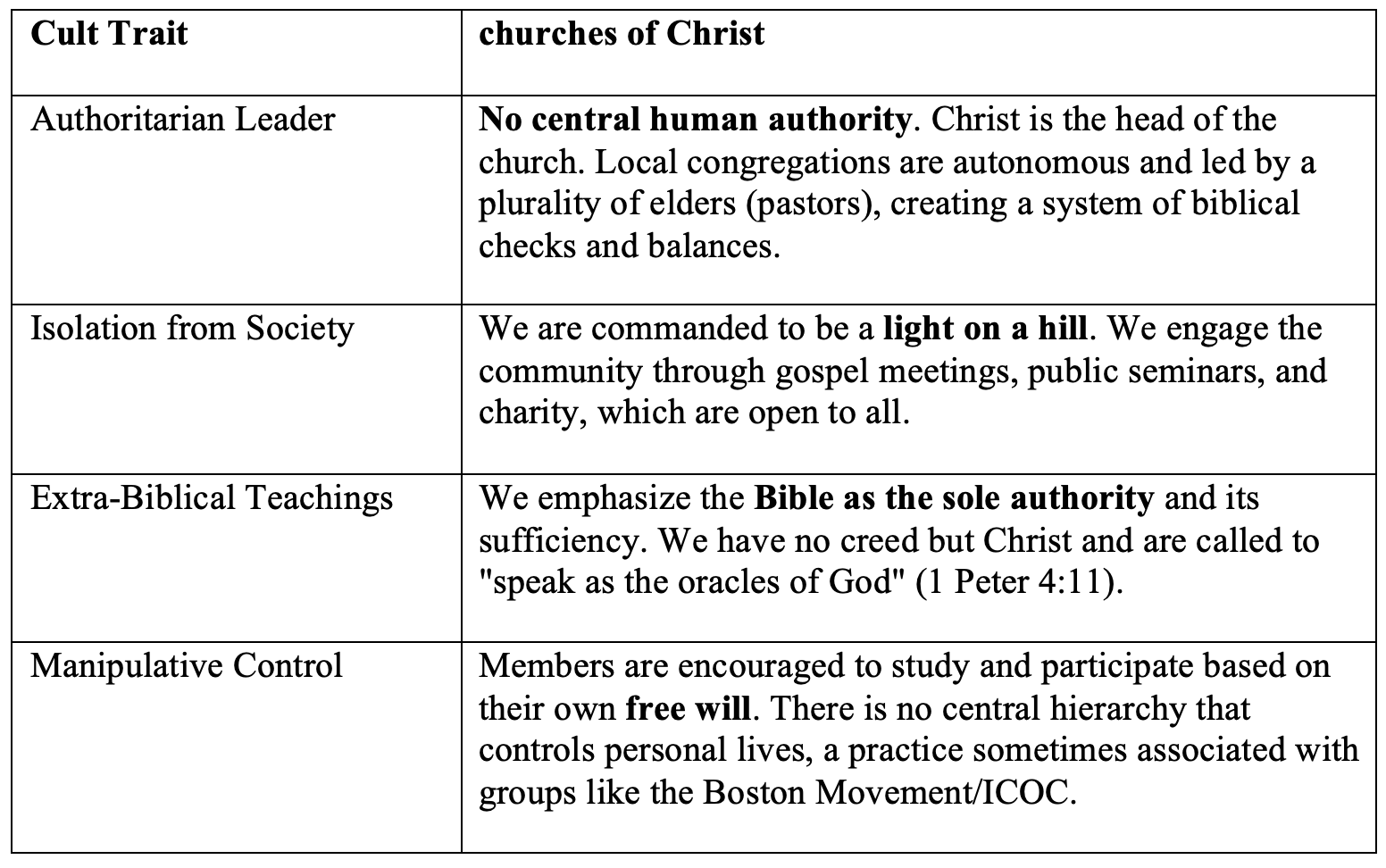
church of Christ vs. Cult Characteristics
When compared against the established definitions of a cult, the church of Christ stands in clear opposition to these traits.
A History of Pejorative Naming
Being labeled with derogatory names is not a new experience for God's people. The early Christians were called a "sect" and their message "heresy".
Acts 24:14 (NKJV): "But this I confess to you, that according to the Way which they call a sect, so I worship the God of my fathers, believing all things which are written in the Law and in the Prophets."
During the Reformation, reformers like Martin Luther were called heretics and blasphemers. The term "cult" itself became a pejorative label in the 20th century, especially after the rise of dangerous groups.
How Should We Respond?
When someone accuses the church of being a cult or claims, "You think you're the only ones going to heaven," our response must be rooted in humility and Scripture.
Answer with Gentleness and Respect: We must avoid becoming defensive or angry, responding with "meekness and fear."
Clarify with Scripture: Humbly state, "We believe that everyone who obeys Christ will go to heaven."
Hebrews 5:9 (NKJV): "And having been perfected, He became the author of eternal salvation to all who obey Him,"
Point to Christ as the Authority: Gently explain that our standard is the Word of God, which will be the basis for judgment for all people.
John 12:48 (NKJV): "He who rejects Me, and does not receive My words, has that which judges him—the word that I have spoken will judge him in the last day."
